
Since the 1960s, Lutheran World Relief has partnered with rural and coastal communities in the Philippines to improve livelihoods, protect natural resources, and strengthen community resilience in one of the world’s most disaster-prone countries. Working with local governments, community organizations and business partners, Lutheran World Relief, now joined by fellow Corus organizations like IMA World Health, helps farming, fishing and rural communities increase production, improve quality, connect to private and competitive markets, fill health gaps and prepare for and recover from crises.
In practice, this means Lutheran World Relief:
- Improves agricultural productivity through regenerative practices, better inputs and appropriate technologies
- Strengthens value chains, producer organizations and private-sector partnerships that expand trade and market opportunities
- Helps coastal and rural communities reduce risk, adapt to climate shocks and steward natural resources
- Supports emergency response and recovery that helps families restore productive assets and livelihoods
- Advances community health through IMA World Health’s expertise in health systems, immunization, nutrition and WASH
Project Highlights
Strengthening Immunization Programs in Sub-National Consequential Geographies
As part of the Corus International family, Lutheran World Relief works alongside fellow Corus organization IMA World Health to improve health outcomes in vulnerable communities around the world. In the Philippines, IMA World Health leads the implementation of a Centers for Disease Control and Prevention (CDC)-funded initiative that is helping strengthen the country's immunization system and expand access to life-saving vaccines.
Working in partnership with the Philippine Department of Health, the project supports efforts to identify and reach underserved populations, improve disease surveillance, and strengthen preparedness for vaccine-preventable disease outbreaks. By enhancing the quality and sustainability of immunization services, the initiative contributes to global efforts to eliminate or eradicate diseases such as polio, measles, rubella, hepatitis B, and maternal and neonatal tetanus.
The project also helps local health systems make better use of data to guide decision-making, builds the capacity of frontline health workers in community engagement and risk communication, and supports stronger disease reporting and surveillance systems. Through these efforts, communities are better equipped to protect children and families from preventable illnesses and build healthier futures.
MOMENTUM Integrated Health Resilience
Lutheran World Relief supports MOMENTUM Integrated Health Resilience (MIHR) through its connection to IMA World Health — a fellow member of the Corus International family. Led by IMA World Health and funded by the U.S. Department of State, MIHR is saving the lives of mothers and children in some of the world's most fragile and conflict-affected settings.
Since launching in 2020, MIHR has worked to strengthen maternal, newborn, and child health systems by building local capacity to deliver high-quality, evidence-based care. The program delivers integrated health, nutrition, and WASH services, supports outbreak response, and improves access to essential medicines across 11 countries—including the Philippines.
In the Philippines, MIHR's work reflects its broader commitment to community-driven, resilient health systems. By partnering with local health authorities, training community health workers, and strengthening data systems, the program ensures that vulnerable populations can access the care they need, when they need it.
Safe Water
Lutheran World Relief was an implementing partner with DAI on USAID’s Safe Water Activity, which worked with local government units, water service providers, and watershed councils in target provinces to strengthen the systems that support and deliver water and sanitation services while protecting critical upstream water resources.
Through the project, Lutheran World Relief engaged upland communities in developing environmentally sustainable livelihoods. The organization promoted agroforestry and watershed management practices, connected community producers to private-sector value chains, engaged corporate partners in water security planning, and developed innovative financing mechanisms to support watershed, forest, and water resource management. These efforts helped strengthen community resilience while contributing to the long-term sustainability of local water resources.
Accelerating Women’s Empowerment through Scaling-up Opportunities for Micro Enterprises and Employment (AWESOME)
In Northern Cebu, Lutheran World Relief partnered with the Philippine Business for Social Progress (PBSP) to strengthen the resilience of 1,000 women through livelihood diversification and enterprise development. The initiative provided capacity-building in disaster risk reduction and management (DRRM), empowering women to lead preparedness efforts at both the household and business levels. Additionally, the project collaborated with the private sector to leverage technology and communication tools, delivering vital access to information on weather, markets, employment, and financing.
Food Secure, Resilient, and Stronger Households (FRESH)
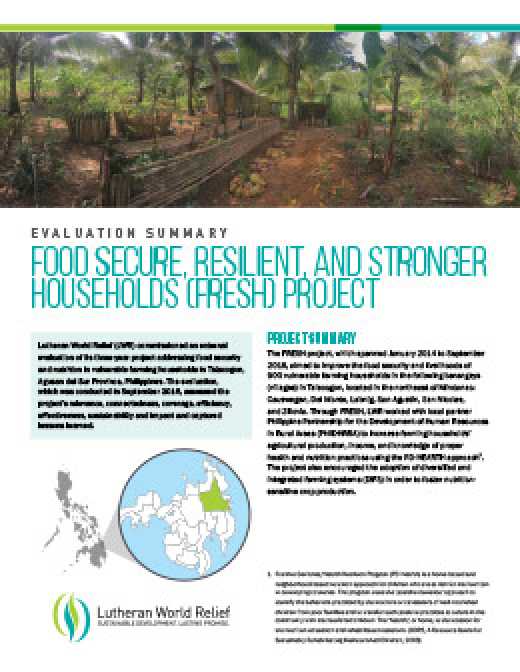
The FRESH project set out to strengthen food security and improve the livelihoods of 900 vulnerable farming households across six barangays (villages) in Talacogon, northeastern Mindanao: Causwagan, Del Monte, Labnig, San Agustin, San Nicolas, and Zillovia. Through the PD-Hearth approach, the project boosted agricultural production and household income, while equipping farming families with a stronger understanding of health and nutrition practices. It also promoted the adoption of diversified and integrated farming systems (DIFS) to encourage nutrition-sensitive crop production.
The results were significant. Over 94% of the 288 malnourished children involved in the project achieved a healthy weight for their age — a milestone largely credited to the PD-Hearth approach and a greater emphasis on growing and consuming vegetables. The project's success resonated beyond its original reach, inspiring local governments in neighboring barangays and municipalities to adopt the PD-Hearth approach in their own communities.
Community-Led Sustainable Sanitation Solutions Project
With the support of the Hilton Foundation, this project focused on four barangays in Ormoc City. Lutheran World Relief trained 66 members across two sanitation committees on WASH activities to eliminate open defecation, while also providing technical support for the construction of over 700 latrines. The project's impact was widely recognized when the local government was awarded first place in "Best Sanitation Practices 2015" in a citywide competition. Lutheran World Relief was also commended for its significant contributions to local WASH development and its effective coordination with local authorities.
Typhoon Haiyan Response
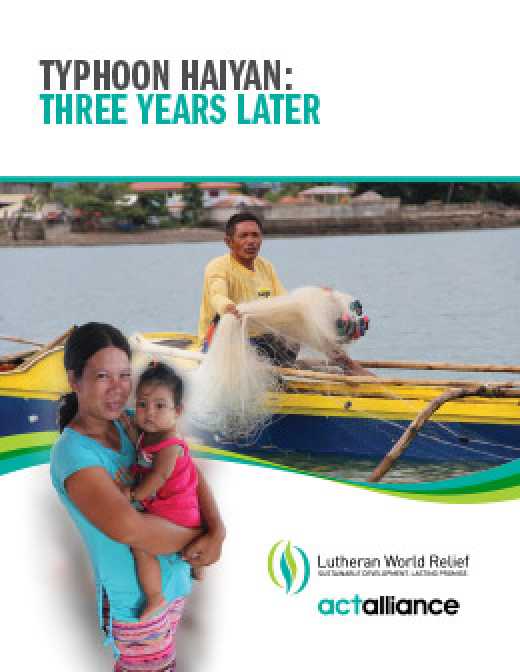
In the wake of Typhoon Haiyan, Lutheran World Relief mobilized to support vulnerable communities through a comprehensive range of initiatives, including the distribution of non-food items, cash-for-work (CfW) programs, shelter assistance, water, sanitation and hygiene (WASH) projects, livelihood rehabilitation, and disaster risk reduction efforts. By September 2014, the organization had distributed 5,345 shelter repair kits, engaged 4,790 participants in CfW programs, delivered 26,873 essential items, and provided training to 489 individuals.
In Leyte Province, Lutheran World Relief's WASH project surpassed its original targets, constructing 739 household latrines and six Material Recovery Facilities (MRFs), while also training local residents in latrine construction. Hygiene kits were distributed to 2,294 households, two sanitation committees were reactivated, and 66 community members received training in Community-Led Total Sanitation (CLTS), collectively benefiting 2,294 households across the region.
Building Resilient Coastal Communities in Mindanao (BRCC)
Lutheran World Relief and the Center for Empowerment and Resource Development (CERD) have strengthened the resilience of Hinatuan’s coastal communities, equipping them to manage climate risks, recover from environmental shocks, and adapt to a changing climate.
Through this initiative, 11 barangays received training in climate-adaptive techniques, including elevated gardening, mulching, garden rain shelters, and cultivating treated seaweed seedlings. To sustain these practices, the project produced comprehensive field guides for future reference. Residents also learned to monitor local weather patterns, sea levels, and water salinity, empowering them to independently assess climate risks and implement timely interventions.
Financial preparedness was another cornerstone of the project. The initiative mobilized and trained 12 Social Protection Committees within local fishers’ organizations to advocate for household savings and disaster planning. As a result, 462 households began saving for their children's education and calamity insurance, while 1,000 residents designed household development plans that incorporate disaster risk reduction and climate-smart strategies.
Reduced Vulnerability by Introducing Viable Economies (ReVIVE)
In partnership with the Mahintana Foundation Inc., Lutheran World Relief successfully mitigated agricultural flooding by rehabilitating and protecting the Silway-Klinan River, its tributaries, and its gullies. The initiative focused on strengthening local disaster risk reduction (DRR) capacities, enabling 13 barangays to establish active Barangay Disaster Risk Reduction and Management Committees (BDRRMCs). These committees instituted vital emergency policies and developed a comprehensive five-year plan for Enhanced Disaster Risk Reduction-Climate Change Adaptation. Furthermore, targeted training in policy-making empowered these communities to formally adopt 15 ordinances dedicated to environmental conservation and public health.
Championing women's empowerment, the project actively promoted female participation in decision-making, resulting in 36 women securing 76 leadership roles within local People’s Organizations. The success of the ReVIVE project was formally recognized by the Environmental Management Bureau of the Department of Environment and Natural Resources (DENR) in its 2013 Water Quality Status Report for Region 12. Celebrated as a model of best practice, the project was praised not only for restoring the river’s physical landscape but also for significantly improving water quality, particularly through the reduction of fecal and total coliform bacteria.
Women-Managed Potable Water System
Lutheran World Relief has installed women-managed water systems across five barangays (villages), delivering clean, potable water to 734 households. By equipping local women’s organizations with the skills to operate these systems and advocate for better water governance, the project fosters lasting community leadership. Additionally, the initiative successfully leveraged public funds and technical support from Gingoog City and local governments to ensure the long-term sustainability of these vital facilities.

Give Where Needed Most
Make sure your gift goes directly to where it's most needed without delay, with a secure online donation.